




If we go by a popular saying, the three most important needs of every human being are food, clothes and a home. While the first two are bare essentials that one can afford rather easily, getting a roof above one’s head requires a hefty financial commitment. This is where home loans have emerged as the saving grace for aspiring home owners.
But there’s often a misconception that one will get the entire property cost as a home loan from a lender. What people forget to take into account is a home loan down payment. As per RBI guidelines, lenders are limited to financing a maximum of 80% of any property value above Rs. 30 lakhs. The rest has to be paid upfront by the borrower.
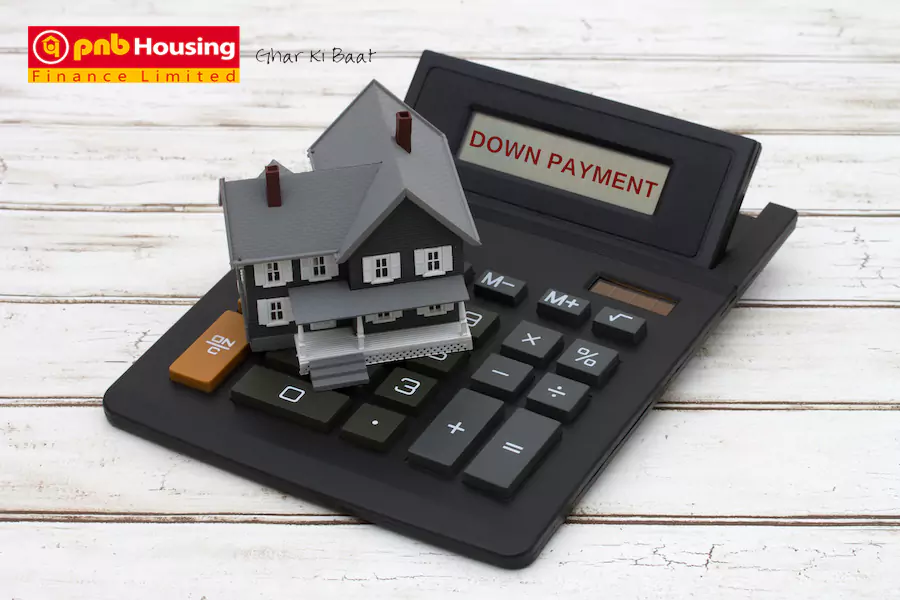
Such an upfront payment is what is termed as the down payment required for a home loan. At first, this may seem like a significant commitment for borrowers, but further insight reveals the distinct advantages of making a down payment.
Let’s learn more about it.
Why Lenders Require Down Payments
Lenders ask for a down payment to reduce their risk and ensure borrowers have a financial commitment to the property. As per RBI rules, financial institutions can finance up to 80% of the property value, so buyers must pay the rest. For example, if a house costs ₹50 lakh, a financial institution may approve a loan of ₹40 lakh, requiring the buyer to pay ₹10 lakh upfront. This prevents over-borrowing and helps in better loan management. A down payment also improves the chances of loan approval and can lead to lower EMIs and better interest rates. Paying more upfront makes home ownership easier in the long run.
Saving up for Down Payment
When you use a home loan eligibility calculator to check how much home loan you are eligible for, be sure to factor in the down payment. This will enable you to plan your home purchase better.
Remember, a down payment to buy a house is not a minor investment. For example, if you want to buy a property in India which costs Rs. 50 lakh, the financial institution will only fund up to Rs. 40 lakh. In fact, depending upon your eligibility status as a result of age, income, tenure, credit score etc., the loan amount could even be lesser.
This means that you will still need to make a minimum down payment for a home loan of Rs. 10 lakh, which is a big amount. Hence, when considering a home purchase via a home loan, make sure to plan how you will save up for a down payment. Here are some tips:
- Invest early:
A good idea is to plan early and invest money for a few years to build up a corpus from which you can make the payment. - Seek proportionate release:
With regard to certain properties and real estate projects, some lenders are willing to let customers pay the home loan down payment in instalments rather than as a lump sum. This is especially true in the case of under-construction properties. Try to avail a proportionate release to make things easier for yourself.
How Not to Make a Down Payment
- The last thing you want to do is dip into your long-term savings or seek a loan against your insurance to fund the down payment for buying a house. That may leave you financially overburdened, and your other EMIs or investments might suffer.
- Moreover, an additional loan for a down payment will hurt your EMI-to-income ratio and prevent you from getting a good home loan deal.
- Dipping into emergency funds is also not recommended, as it will come in handy during actual medical contingencies, disasters or unforeseen situations.
Must Read: How to Improve Your Home Loan Eligibility?
Benefits of Making a Larger Down Payment
Making more than the minimum down payment for a home loan will enable you to possess more equity in the property. This means that your need for borrowing a large home loan amount goes down.
- As you pay a higher down payment required for the home loan, you can avail more favourable terms for the reduced principal amount. Given the fact that many lenders have different loan slabs, a lower loan slab may yield a lower rate of interest and a lower EMI too.
- Of course, the less money borrowed, the more quickly you can pay off your home loan. You also get to save on additional home loan processing costs or insurance premiums.
- Lastly, a lesser loan amount provides more comfort to the lending institution and, as a result, increases the likelihood of faster loan approval.
For example, if you take a ₹40 lakh loan at 8.5% for 30 years, your EMI will be ₹30,757, and the total interest paid will be ₹70.72 lakh. But if you increase the down payment and take a ₹30 lakh loan instead, your EMI will drop to ₹23,067, and the total interest will be ₹53.04 lakh.
How Much Should You Pay as Down Payment?
The down payment required for a home loan depends on the lender and the property value. Some lenders mandate 20-30% of the home’s price as a down payment, while others offer loans with as little as 5% upfront. It is always advisable to check the lender’s terms and negotiate for a lower down payment if needed.
PNB Housing Finance offers home loans covering up to 90% of the property value, reducing the immediate financial burden on homebuyers. A higher loan-to-value ratio means buyers can secure a home with a lower upfront investment while still ensuring manageable repayments.
Common Myths About Down Payments
- Myth 1: You Must Pay 20-30% as a Down Payment
Lenders like PNB Housing offer loans with just a 10% down payment, depending on eligibility and property type. - Myth 2: A Higher Down Payment is Always Better
While a larger down payment reduces loan interest, it’s essential to maintain liquidity for other financial needs. - Myth 3: Down Payment Must Be Paid in One Lump Sum
Some lenders allow instalment payments, especially for under-construction properties. - Myth 4: Taking a Loan for a Down Payment is a Good Idea
Borrowing for a down payment increases the debt burden and affects the chances of loan approval.
Wrapping Up
When you put down more money, you will get better home loan terms and home loan interest rates . Hence, if planned better, a home loan down payment can help you avail a more affordable home loan. Of course, the keyword here is planning.
At PNB Housing, we provide great flexibility to all customers for their down payment. Consult our experts today to figure out the ideal down payment for you and any other home loan query.
FAQ Answers
How does the size of my down payment affect my home loan?
A larger down payment reduces the loan amount, leading to lower EMIs, reduced interest costs, and quicker loan repayment. It may also help in securing a better interest rate. On the other hand, a smaller down payment increases the total loan burden and overall repayment amount.
Can I negotiate the down payment amount with the lender?
Yes, some lenders allow flexibility in down payment amounts, especially for under-construction properties or borrowers with strong financial profiles. You can discuss options such as proportionate release, instalment-based payments, or lower upfront contributions based on your creditworthiness and relationship with the lender.
Is it better to pay a larger down payment or keep more cash on hand?
It depends on your financial situation. A larger down payment reduces loan costs and interest but may strain liquidity. Keeping cash reserves ensures financial security for emergencies, investments, or future expenses. It's best to strike a balance based on your income, savings, and future plans.
What happens if I can't afford the required down payment?
If you can’t afford the required down payment, explore options like low down payment loans (5-10%), government-backed loan schemes, or saving over time. Avoid taking additional loans for the down payment, as it increases your debt burden and may reduce your home loan approval chances.