




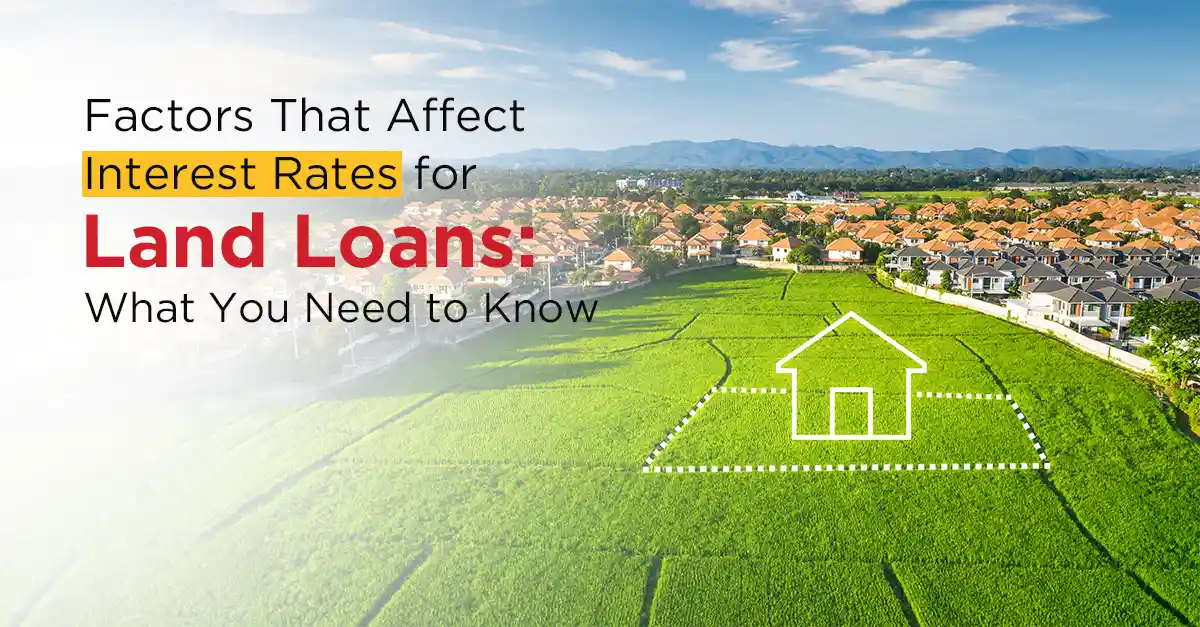
Purchasing land is a significant financial decision, and understanding the factors that influence interest rates for land loans can help you secure better terms. Land loans typically have higher interest rates than home loans because they are considered riskier by financial institutions due to the absence of a developed property as collateral. Factors such as the type of land (raw, improved, or lot), your credit score, loan-to-value ratio, down payment size, and loan term play a crucial role in determining the interest rate. By being aware of these elements, you can make informed choices and improve your chances of obtaining favourable financing.
Why Land Loan Interest Rates Are Higher Than Home Loans
Land loans typically carry higher interest rates than home loans. This difference arises because financial institutions consider land a riskier asset. Unlike constructed properties, land doesn't generate immediate returns, making it a less secure form of collateral. Consequently, financial institutions offset this risk by imposing higher interest rates on land loans.
Credit Score: How it Impacts Your Land Loan Interest Rate
Your credit score plays a pivotal role in determining the interest rate for a land loan. A higher credit score indicates responsible financial behaviour, making you a less risky borrower in the eyes of financial institutions. For instance, PNB Housing Finance offers varying interest rates based on credit scores:
- Credit Score >= 825: Interest rates range from 9.50% to 10% for salaried/self-employed professionals and 9.80% to 10.30% for self-employed non-professionals.
- Credit Score between >700 to 725: Interest rates will be higher by approximately 1%.
Maintaining a strong credit score can thus lead to more favourable loan terms.
Type of Land: How it Influences Loan Terms
The nature and location of the land significantly affect loan terms. Financial institutions assess factors such as:
- Location: Urban plots may be viewed more favourably than rural ones due to higher resale value.
- Zoning Regulations: Residentially zoned land might attract better terms compared to commercial or agricultural land.
Understanding how the type of land influences loan terms can help you anticipate the interest rate for land loans you might be offered.
Fixed vs. Floating Interest Rate: Which One Is Right for You?
When securing a land loan, you'll encounter two primary types of interest rates:
- Fixed Interest Rate: Remains constant throughout the loan tenure, providing predictable monthly payments.
- Floating Interest Rate: Fluctuates based on market conditions, which can lead to varying monthly payments.
Consider a couple taking a Rs. 10,00,000 loan for 10 years at a 9.5% rate of interest. Their monthly payment under different rate structures might look like this:
| Detail | Fixed Rate Loan (9.5% p.a.) |
Floating Rate Loan (starts at 9.5% p.a.) |
|---|---|---|
| Monthly EMI (approx.) | Rs. 12,940 | Rs. 12,940 initially (for ex) may rise to Rs. 13,662 if the interest rate rises to 10.80% |
| Payment Predictability | Stable and predictable | Variable with market changes |
| Budgeting Impact | Easier to plan expenses | This may lead to higher payments if rates increase |
This example shows how a floating-rate loan can become costlier if market rates rise over time.
Choosing between fixed and floating rates depends on your financial stability and risk tolerance. Fixed rates offer certainty while floating rates might be beneficial if you anticipate a decrease in market rates.
Loan Tenure: Shorter vs. Longer Duration—Which Saves You More?
The length of your loan tenure impacts both your monthly payments and the total interest paid over time:
- Shorter Tenure: Higher monthly payments but less total interest paid.
- Longer Tenure: Lower monthly payments but more total interest paid.
Selecting an appropriate loan tenure requires balancing your monthly budget with the goal of minimising total interest costs.
Economic Conditions: How Market Trends Impact Land Loan Rates
Economic indicators such as inflation rates, monetary policies, and overall economic growth influence the interest rate for land loan. For example, a reduction in the Reserve Bank of India's repo rate can lead to lower lending rates. Staying informed about economic trends can help you time your loan application to secure better rates.
Wrapping Up
Understanding the factors that affect the interest rate for land loans empowers you to make informed decisions and potentially secure more favourable loan terms. By considering elements like your credit score, the type of land, and current economic conditions, you can manage the land loan process more effectively.
FAQs
Why are land loan interest rates higher than home loan rates?
Financial institutions consider land loans riskier because land doesn't generate immediate returns and lacks structures that can serve as collateral. This increased risk leads to higher interest rates compared to home loans.
How does my credit score affect my land loan interest rate?
A higher credit score demonstrates responsible financial behaviour, reducing the financial institutions' risk. Consequently, borrowers with higher credit scores often receive lower interest rates on land loans.
What is the maximum Loan-to-Value (LTV) ratio for a land loan?
The LTV ratio represents the percentage of the property's value that can be financed through a loan. For land loans, financial institutions typically offer up to 70-75% of the land's value, depending on factors like the borrower's credit profile and the property's characteristics.
Does the type of land impact the loan interest rate?
Yes, the type and location of the land significantly influence loan terms. Financial institutions generally view urban, residentially zoned plots more favourably, potentially resulting in better interest rates compared to rural or non-residential land.